FuelOpt Explained: The Crew-Aiding System That Eliminates Execution Variance
A voyage plan is only as good as its execution. Fleet managers and commercial operators know this. You can invest in the best routing software, the most experienced crew, and the most efficient vessel in your segment, and still find results that fall short of what was calculated on paper. The gap between the plan and what actually happens at sea is not a technology problem. It is an execution problem.
FuelOpt, developed by Manta Marine Technologies, is designed to close that gap.
Even the most experienced captain in the world cannot achieve 100% accuracy on voyage instructions. Not because of skill, but because of the continuous, manual nature of the task. FuelOpt gives the crew the tools to reach that accuracy.
What Is FuelOpt?
FuelOpt is a crew-aiding system installed onboard and integrated directly into the vessel's propulsion system. It operates in real time, maintaining setpoints for speed, fuel consumption, or shaft power, and then controlling propulsion output to maintain those parameters continuously and automatically.
A captain navigating a full voyage has a great deal to manage: weather, route decisions, crew coordination, administrative tasks and real-time situational awareness. FuelOpt takes the task of continuously managing propulsion parameters off that list. It gives the crew a precise, reliable tool so their attention can go where it matters most.
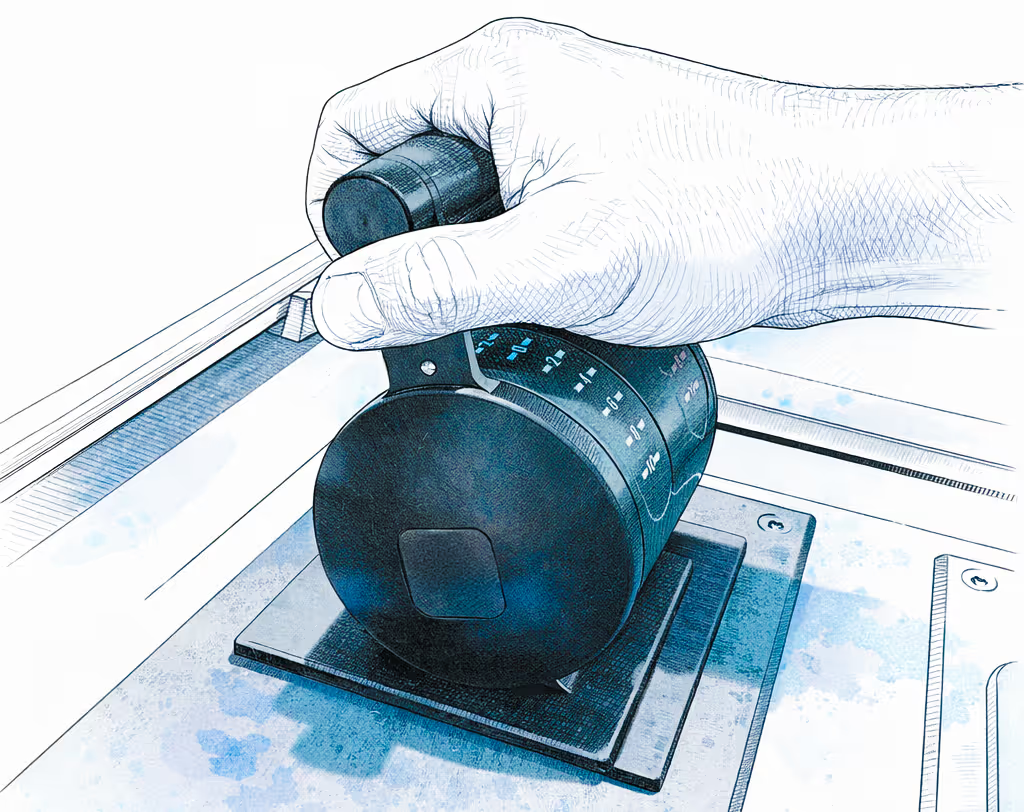
The bridge interface is deliberately simple. There is an on button, an off button, and two dials: one for speed and one for consumption. The crew set the desired parameters, activate the system, and FuelOpt handles the execution. The captain retains full authority and can override at any time.
What FuelOpt Delivers
Imagine the most skilled, most experienced captain imaginable: someone with perfect consistency, perfect attention, and no fatigue. A captain who can execute the voyage plan with complete accuracy and precision, every time, and adapt to unforeseen environmental conditions without deviation.
The difference in operational performance between that captain and the reality of manual voyage execution across a full fleet will be varying, but it will be real and measurable. Fatigue, distraction, competing priorities and the sheer continuity of the task mean that even the best crews will produce some variance against the voyage plan over time.
FuelOpt gives every captain on every vessel in your fleet access to the highest level of execution precision. The crew remain in command. FuelOpt makes sure their intentions are carried out exactly.
The fuel savings that operators report come from pairing FuelOpt with a well-constructed voyage plan and, where applicable, complementary technologies. FuelOpt is the execution layer that ensures the plan actually becomes reality.
The Three Modes: Speed, Consumption, and Power
FuelOpt operates across three modes, each corresponding to a different control parameter.
Speed Mode controls shaft power to maintain a target speed over ground (SOG) or speed through water (STW). This mode is particularly valuable when integrated with Wind Assisted Propulsion Systems (WAPS), where holding a target speed means that additional energy from wind is converted into fuel savings rather than unplanned acceleration.
Consumption Mode targets a steady fuel consumption rate. Most customers design their voyage instructions around consumption, making this the most commonly used mode in practice.
Power mode suits operations where consistent engine load is the priority and achieves measured accuracy consistently above 99.8%. Fixed power is becoming more common in the industry as best practice. A reliable vessel model that can translate speed to accurate shaft power is a prerequisite.
The modes can be used individually or in combination. A common configuration is speed mode paired with consumption mode, which allows the vessel to slow down in adverse weather while preventing it from overconsuming to compensate.

Dynamic Power Limits: Protecting Performance at the Extremes
One practical challenge in real-world operations is the auxiliary power range, specifically the power band where aux mode is triggered if load drops too low. FuelOpt addresses this directly through dynamic power limits, which can be configured to keep the system operating outside critical ranges that would otherwise interfere with vessel performance.
These limits are set per vessel and per operation. They are not a workaround. They are a design feature that reflects the reality of how vessels actually operate.
How FuelOpt Works With Other Technologies
FuelOpt does not replace other technologies on your vessel. It amplifies them. As explored in our recent article on Precision Execution: The Critical Factor in Maritime Fuel Efficiency Technologies, the missing link for many green technology investments is not the technology itself, but the ability to execute consistently against the parameters those technologies require.
The most illustrative example is Wind Assisted Propulsion. When the wind is favourable, a WAPS system provides meaningful additional thrust. Many operators record this as a fuel saving, and it can be, but only if the vessel holds its planned speed rather than accelerating. With FuelOpt active, the speed setpoint holds. The additional energy from the wind is not absorbed by higher speed. It is absorbed by reduced engine load. The fuel saving is real and measurable.
The same logic applies to Air Lubrication Systems and any other technology that alters the propulsion equation mid-voyage. FuelOpt ensures the crew's setpoints are respected precisely, so that the full benefit of each technology is captured.
Fuel Type and Vessel Compatibility
FuelOpt is compatible with all fuel types and operates across all vessel types and operational profiles. Whether your fleet runs on VLSFO, LNG, methanol, a blend or a combination of the above, and whether you operate bulk carriers, tankers, container vessels, cruise vessels or RoRo/RoPax, FuelOpt integrates with the propulsion system directly and operates independently of fuel specification.
The Fleet Performance Team: Turning Data Into Strategy
FuelOpt does not operate in isolation from Manta's broader offering. Post-voyage, the data gathered by FuelOpt feeds into Fleet Analytics, Manta's platform for operational analysis and emissions reporting. The Fleet Performance team works with operators to review this data, assess how setpoints performed against actual conditions, and recommend adjustments for future voyages.
Over time, this process builds an operational profile for each vessel. A set of setpoints and parameters that reflects the vessel's actual behaviour across different routes, seasons, and load conditions. The result is a continuously improving execution strategy, grounded in real data rather than assumptions.
This pairing of crew expertise and technology precision is also central to how Manta thinks about seafarer wellbeing, as discussed in Embracing Technology to Support Seafarer Safety. When crew are supported by tools that handle precision execution automatically, they have more capacity for the navigational and safety decisions that genuinely require their experience and judgment.
Who Should Be Looking at FuelOpt?
- Fleet managers who have invested in voyage optimisation software but are not confident that voyage instructions are being executed with sufficient accuracy.
- Technical superintendents managing mixed fleets where conditions vary between vessels and trades.
- Commercial operators whose charter agreements or CII obligations depend on predictable, documented performance.
- Any operator running WAPS, ALS, or similar efficiency technologies who wants to ensure those investments are delivering their stated benefits.
If your voyage plan is sound and your crew are skilled, FuelOpt is the tool that makes sure their intentions are carried out with the precision the plan requires.
Interested in learning more on how FuelOpt can support more consistent and efficient operations
Contact us!

Oliwia Gałecka
Oliwia holds a degree in Naval Architecture and Marine Engineering and has experience working with shipowners, regulatory bodies, and commercial environments across the marine industry. She joined Manta Marine Technologies in January 2026, where she works as a Fleet Performance Analyst.